nmoreau's Blog

Random Notes and thoughts
Blockchain basics and tradeoffs
by Moreau
In this post, I am trying to extract the essence of what makes blockchain similar and different from any other storage system. This is agnostic to any particular instantiation (Bitcoin, Ethereum, …) and is a general definition.
Basic definition: a Permissionless Decentralized Immutable Ledger
- Ledger : a data structure to store account state and transactions
- Immutable : the state cannot be altered or attacked by a third party. The state can be verified,
- Decentralized : the ledger is running on multiple distributed computers to read or write. It cannot be turned off.
- Permissionless : anyone can become a user of the ledger and claim an account. You just need a Pub/Priv key pair
Breaking down further
- Storage - Database storing state : What address has what.
- Updating state - You need to hold the key (private key) to a particular to initiate a tx from this address to another
- Committing state - Every period, the transaction in the backlog (mempool) a taken by minors/validators to update the state.
- Miners/validators have incentives to secure the network and earn rewards (aka: block reward)
- Execution layer - Smart contact is code deployed on a blockchain an can interact with the chain. You can send a Tx or Data to a Smart Contact address.
3 Attributes of Blockchain
- Persistent / Irreversible / immutable - Cryptographicaly secure
- Distributed / No Downtime / Fault tolerant
- Permissionless / Decentralized - Anyone can participate - Censorship resistant
A fine balance between 3 Trade offs
There is a fine balance to find between these 3 attributes.
- Decentralized - If you increase the bar for the min hardware/infra requirements (ex: storage capacity, min bandwidth, compute), then you exclude de factor actors to participate
- Scalable : # of Tx per sec, size of the data stored on Chain
- Secure : It cannot be compromised, vs some actors could decide to collude and influence / try to take control.
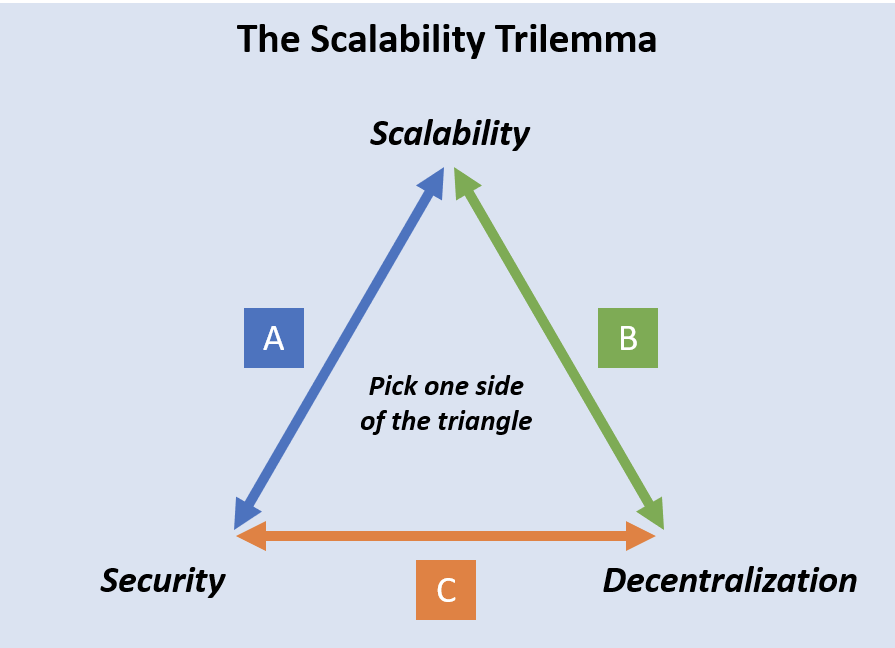 source Michael Zochowski